
Part II · Chapter XXIV
An Apparition of Death
When woke, it was still dark, and the cold nipped at every part of him left uncovered. He rubbed his toes and breathed in the harmattan chill—how was the rain already nearly finished? He wasn’t one to check the calendar obsessively, counting every market day and free day to hold time in his mind. He was far more used to reading the weather cues, and the fog was one even a fool could not miss. For one thing, it made morning hunts nearly impossible. In Eke, even ten paces away were enough for the morning dew to swallow a man. A rabbit only had to scamper a few paces to disappear. He turned to find still sleeping, something he never thought he would see in his entire life. For as long as he could remember, there hadn’t been a morning when his father had not risen first. Most times, when Anyi was still waking, the older man had already bathed and meditated in his shrine.
‘He normally wakes very early.’ Anyi spoke towards the healer, who seemed distracted, staring into the fog.
‘I’m sorry. I thought I saw someone there.’
Anyi knew better than to ask if it was her husband or one of her sons. He searched her eyes for tears, but in the half-light he found only a gleam—and that said enough.
‘The medicine I gave him also helps with sleep. The body repairs best when we sleep,’ she repeated softly into the fog, blinking as if searching for an apparition about to vanish. Anyi gazed too, but he did not blink. From where he sat, there was nothing to see, nothing to strain for. It made him wonder how much of the world was truly as it was, and how much was only as he saw it.
‘Child, do you know what happens when we are deprived of sleep for days?’
‘They say it causes madness.’
‘Fools!’ The healer scoffed, then laughed so lightly it made Anyi wonder whether she herself had been getting enough sleep.
‘What the spiritually blind call madness is no madness at all. They are the same people who call dreams mere fantasies without purpose. Fools.’
Anyi kept his gaze on the woman, scanning his memory to gather pieces of her he might have missed. It was strange for a widow to choose a man and his son to follow into a new kingdom. What of her relatives in their village? Her parents, if they still lived? Had they all cast her away for standing against the pig-man?
‘Dreams are your chi’s way of speaking to you, because the mind of chi has no language of its own; it understands only symbols. When you do not sleep, it is like holding your breath. Eventually, it comes rushing out—even when you don’t want it to.’
‘So you are saying that when you do not sleep and dream, the images from your dream find you awake?’ Anyi widened his eyes to chase away the sleep still lurking in them.
‘I am saying to you that I have not slept a wink and have eaten almost nothing in the last three days. Right now, I see my husband and our sons standing in the fog.’ She leaned forward as if to peer closer. ‘I know that you do not see them, that you cannot see them. After all, one cannot dream a face they have never seen, just as they cannot imagine a colour they have never known.
‘I try to teach the boy the most basic principles of his chi, and you chastise me for giving a goat meat to eat. Yet here you are, feeding the same goat bones to chew.’
‘Ibolachi,’ Anyi greeted his father.
‘How are you feeling?’ the healer asked.
Nnanyi looked around him as if searching for his own body.
‘I am well. I feel better. Stronger.’
‘That is good. We should get going soon.’
‘Nnanyi, the d’bia-ogwu has not slept.’ Anyi rushed his words, unsure if it was worry or a telling on.
‘I need to open my dream eyes, warrior. There is too much going on for the naked eyes alone to see.’
Nnanyi’s face tightened into to a frown, then quickly smoothed again into calm.
‘I have heard seers speak of anya-chi, the dream eye. I myself once had to visit the d’bia-agwu in Eke to explain what mine was seeing. I didn’t know that d’bia-ogwus see too. I thought you were concerned more with herbs.’
‘And you think we discovered that dongoyaro cures the bitter-mouth fever by brewing every single bark in the forest?’
The words were meant for Nnanyi, but Anyi caught them.
‘All d’bias can see, or at least understand how it works. But d’bia-agwus, who specialise in matters of the mind, are more suited to interpreting and even navigating the dream eye.’
Nnanyi nodded.
‘So long as you do not faint on the way,’ Nnanyi conceded.
The d’bia-ogwu paused for a breath.
‘I cannot promise you I will not fall into a slumber, but your watching over me would be worth the vision I bring back from uwa mmuo—the spirit realm.’
Anyi saw worry in his father’s eyes. For a moment, he seemed to have travelled to another dimension. He returned with a wiggle of his jaw, but whatever he had considered saying, he decided against.
‘Do not let the words you fear to speak choke you.’
Nnanyi said nothing.
‘Is it about your dreams?’ The d’bia-ogwu’s eyes widened in a way that startled Anyi. ‘What did you see, ogbu’agu? What did you see that frightens even you, leopard-killer?’
‘There is no time to explain. What has come to Onicha is coming to Eke. Now let us go. We must reach home in time to tell our people what is coming.’
‘So they may prepare for death—or for surrender?’ the d’bia asked.
‘We should get going, d’bia.’
They walked the familiar forest paths cautiously, wary of pig-men lurking with their rifles. By noon, the sun was scorching, biting at the nape of Anyi’s neck and pounding on his head. Nnanyi poured with sweat, and the sleep-and-food-starved d’bia-ogwu staggered with every step.
‘Are you –’
Anyi’s tongue was still forming the words when she swayed too far to one side, and before he could reach her she collapsed, sending a gust of harmattan dust into the air. He and his father quickly lifted her from the path and carried her into the shade. They laid her at the foot of a tree, propping her against the thick roots that spread from its trunk.
‘Do we wake her?’ Anyi asked.
Nnanyi studied the sun’s position, then glanced at his shadow on the ground.
‘We aren’t far from Eke. We will rest here until the sun sets. By evening, she will be awake.’
The pair sat in the shade with the sleeping d’bia. Time crawled like the ants that made homes in the tree, and soon the heat had forced them to drink most of their water. When the worst of the scorch had passed, darkness began to crawl over the forest, lengthening the shadows as it did.
‘Alu!’ The d’bia’s voice jerked Anyi and his father from the drowsy drift the cool air was starting to bring.
‘Chai, chai, chai!’ she exclaimed, snapping her fingers to shake off the vision. ‘Nmba, nmba, nmab—Chukwu aju! Chukwu aju!’
‘D’bia, you are scaring us. Are you all right? What did you see?’
The d’bia turned towards them and Anyi saw her eyes widen, bulge and tremble with fear.
‘I… saw…’ Her eyes darted to Nnanyi, then to Anyi, and back to Nnanyi.
‘You saw what?’ Nnanyi snapped.
‘So much blood,’ she whispered. ‘You must surrender—resistance is futile. You must.’
‘So it is only a little blood that scares you? That’s what makes you scream as if you are in labour?’ The older man scoffed, turning to Anyi. ‘Pay her no mind, I’m sure it’s the same dream I had.’
Anyi watched the d’bia’s eyes hover and his stomach churned, a deep fear growling in his belly. He could not say what it was about the d’bia’s eyes, but there was something there—something that made him shudder: a dark premonition.
‘Who is there?’ a voice rang from the path. Nnanyi moved a hand to his blade and Anyi reached for his long knife.
‘Put that away,’ the d’bia said, looking straight at Nnanyi. ‘This is not where you die.’
‘What are you talking about?’ Nnanyi asked, his grip unyielding.
The rustle of leaves drew closer until two masked men emerged, spears in hand and whips at their sides.
‘You should not be out at this hour, ogbu’agu,’ one of them said. Anyi flinched at the mask—a charcoal-black carved face with white, jagged teeth and wild red scars like tribal marks across its cheeks, a raffia mane resembling a lion’s.
‘We were travelling and the d’bia needed a rest. She is from Onicha. Though with what it has become, I am not sure I can still call it that.’
‘We hear the pig-men have all but dethroned their Obi,’ the other masked man replied.
‘Do you still call him an Obi? He is at best a mediator, and most likely a slave. Perhaps one with wealth and title, but a slave all the same.’
‘Alu.’ It was hard for Anyi to tell which of the men spoke with their faces covered. ‘We have been asked to patrol these areas. With how quickly these pig-men are moving in, we must act faster or they will overrun us too.’
The d’bia’s words rushed back to Anyi. At first they had stunned him into numbness, but now he was awake. What had the d’bia seen, really? This is not where you die…
‘Let us go to the Eze’s obi. I have seen many things on my travels that I must share with him. These men are not merely after our land, it is our very chi they hope to destroy. I fear that the war we did not want has come to us.’
In the dark Anyi could still make out the men’s muscular arms; even as they breathed lightly, their chests heaved. In near silence they followed the familiar path to Eke. Anyi noticed his father taking in the kingdom with the eyes of a stranger, as if he were trying to store the memories somewhere beyond the reach of time.
‘Do you know why our kingdom guards wear these masks?’ Nnanyi asked. Anyi hesitated, afraid that what seemed obvious might be the wrong answer.
‘Is it because the masks are frightening and weaken the enemy with fear?’
Nnanyi nodded, but as Anyi suspected, there was more to it.
‘The Umudiokpa and the Ekpe society provide guards to protect the kingdom. One day, it might even be your job—after all, you too are a first-born son.’
Anyi looked at his arms, searching for muscles he did not have.
‘Don’t worry, your body will change in time. You will go from ropey Anyi to dike kalaka like me.’ Nnanyi flexed his arms and it made Anyi chuckle. Only when his face relaxed did he realise how long it had been since he felt safe. And just as quickly as the feeling had come, it was gone. He could not say how he knew, but the worst was yet to come. Eke was no longer a safe home.
‘Now imagine you were to patrol the streets on a night when no one is allowed out, and I, your father, was caught on the street.’
‘Caught by me? You mean I will have to flog you?’ Anyi asked.
‘We have to do what must be done. Sometimes that means doing it behind a mask. That way, when we see each other in the morning, I may understand it was not you as my son who flogged me, but you as a guard.’
‘You would rather spend your last moments passing on everything you know to the boy than surrender and live long enough to teach him until he comes of age,’ the d’bia chimed in.
Nnanyi was silent for a few paces, weighing what increasingly felt like fate.
‘I may tell him a million things and they will go in one ear and out the other. But what I show him, he will never forget.’
‘And what do you hope to show him by choosing to die?’
Nnanyi set his jaw. ‘That men should never be afraid of death.’
Anyi walked in silence, replaying his dream and breathing steadily, as if to expel the dread in his lungs. When they reached the Eze’s palace, he was glad at the thought that he might see that night. More than anything, he wanted other thoughts to occupy him—thoughts free of pig-men, imminent death, or symbols he could not read.
‘Tell the Eze I bring news from Onicha. Tell him we must roll out the ekwe drum and beat it loud to the tune of war.’ Nnanyi passed the message to a young man in the compound, and Anyi was pulled back into the place he most hated—fear.
Eze Eke
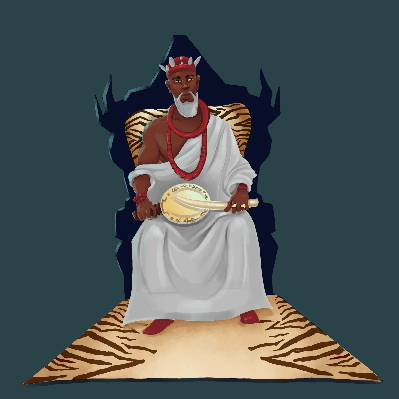
The Eze is a Priest-Guide selected by a council of leaders to preside over the kingdom for seven years. He can be identified by an eagle-feathered crown and an elephant-tusk staff of office, representing his ofor.
The elephant tusk is considered a sacred object, a symbol of truth. It is used only for titles denoting a person’s character, such as the Ichi Ozo for men or Igbu Odu for women.