
Essays · The Dekolonial Paperz · 12
Cultural Aesthetics (Memes R Us)
William Ifeanyi Moore · 4 min
It's me, it's me, it's us, it's us…
Cultural aesthetics is the physical manifestation of a people's thought system, generally presented in an array of art forms ranging from as little as ornaments, scripts, and furniture, all the way to fashion and even architecture. You only have to take a look at every other culture over the ages to see how these aesthetic forms have constantly been transferred from one generation to another.
In Japan, for example, while globalisation has seen the erection of skyscrapers and other such modern structures, there are still a lot of design choices that borrow from the dynastic eras popular in Japanese art even today. The same can be said of China, as they still maintain attributes like their emphasis on the colour red, and the constant projection of traditional Chinese culture through their popular masquerade festivals and other such activities to ensure the propagation of the people's traditional aesthetic.
In fact, the popular Japanese-American designer George Nakashima, credited for the live-edge table design, is an example of how even in modern times, people can still draw on their traditional modes of aesthetics to produce work. In this case, we see the Japanese affection for asymmetry expressed in concepts like wabi-sabi, producing a table that doesn't necessarily look like it cares about geometric balance. Car production is another area one could examine to see how these aesthetic histories play out even in modern machines. If you know much about cars, then you will know European cars, American cars, and Asian cars always found a way to represent the conservative or extravagant nature of their native cultures.



But the story of aesthetics does not end only in design. We see it too in writing — on the script level, and not the sentence level. On the script level, while Egypt is famous for its hieroglyphics, Ge'ez in Ethiopia actually offers the phonographic style of text generally accepted as writing by the Western paradigm. Interestingly though, a logographic writing style like nsibidi, which was used around the Eastern regions in modern Nigeria, provided a mode of written communication that transcended the spoken languages of which multiple existed within the region.
If a computer language is developed today that allows systems operating with different languages to communicate, it is more likely to be praised for sophistication than to be regarded as primitive; yet the genius behind these other forms of writing is often ignored, as the forms are quick to be branded primitive. These forms of text that focus largely on the conveying of abstraction to be translated by the reader are often considered an invalid form of communication by the Western paradigm, which constantly aims for literary precision.
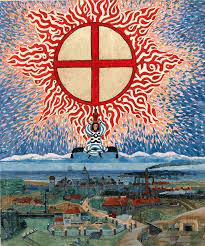
In storytelling, while the Western canon often excludes Homer from the conversation, literary merit has often been reserved for works that are grounded in what can be contained in observable reality. In fact, the genre itself is called "literary" fiction, so it's clear that it is the standard for literature. Other cultures that accommodate other forms of reality, that may choose to incorporate their views into their stories, quickly fall into categories like magical realism, surrealism, and even fantasy. Even within Western writers, Carl Jung — who is sometimes referred to as the Western Shaman — is often not paid his dues in the field of psychology just because his work is rich with content that isn't exactly "observable" in a lab. Examples include his concepts of the animus, anima, archetype, collective unconscious, and other such psychological forces that can appear like parapsychology to the material scientific mind looking for measurements in all truths.
Unfortunately or fortunately, English and French have become the dominant languages for text in many African countries; but even within the confines of another tongue, writers like Chinua Achebe have often attempted to carve out a style that mirrors more closely our way of speaking, so the work doesn't lose all African aesthetic quality to the European standard. The question of whether these literary standards will carry on forever brings to mind the four-time denial of the Nobel Prize to H. G. Wells because he wrote science fiction.